
Whether you're a beginner, intermediate or experienced rider, choosing the right snowboard is essential to improving your performance and getting the most out of every day on the mountain. The benefits are numerous: better performance through improved maneuverability and stability, increased confidence and safety on your board, greater comfort without unnecessary pain or discomfort, and an overall better riding experience with a snowboard that truly matches your expectations and specific needs.
English below
Que vous soyez un rider de niveau débutant, intermédiaire ou expérimenté, le choix de votre snowboard est un aspect essentiel à prendre en compte pour améliorer vos performances et prendre un maximum de plaisir. Plusieurs bénéfices à la clé : optimiser vos performances en gagnant en maniabilité et stabilité, s’assurer la sécurité en étant plus en confiance sur votre planche, gagner en confort en ne souffrant d’aucune douleur ou inconfort, et améliorer votre expérience de glisse en optant pour un snowboard qui répond à vos attentes et vos besoins bien spécifiques. L’équipe Stone Snowboards Canada vous donne ses conseils experts à travers ce guide complet : comment choisir son snowboard ?
Comprenez les bases du snowboard
Commençons par le commencement : reprenons les bases du snowboard. Avant de prendre en compte les éléments pour savoir comment choisir son snowboard, il est essentiel que vous sachiez de quoi est composé un snowboard. Chaque partie a un rôle spécifique et influencera à sa façon votre performance de glisse ?
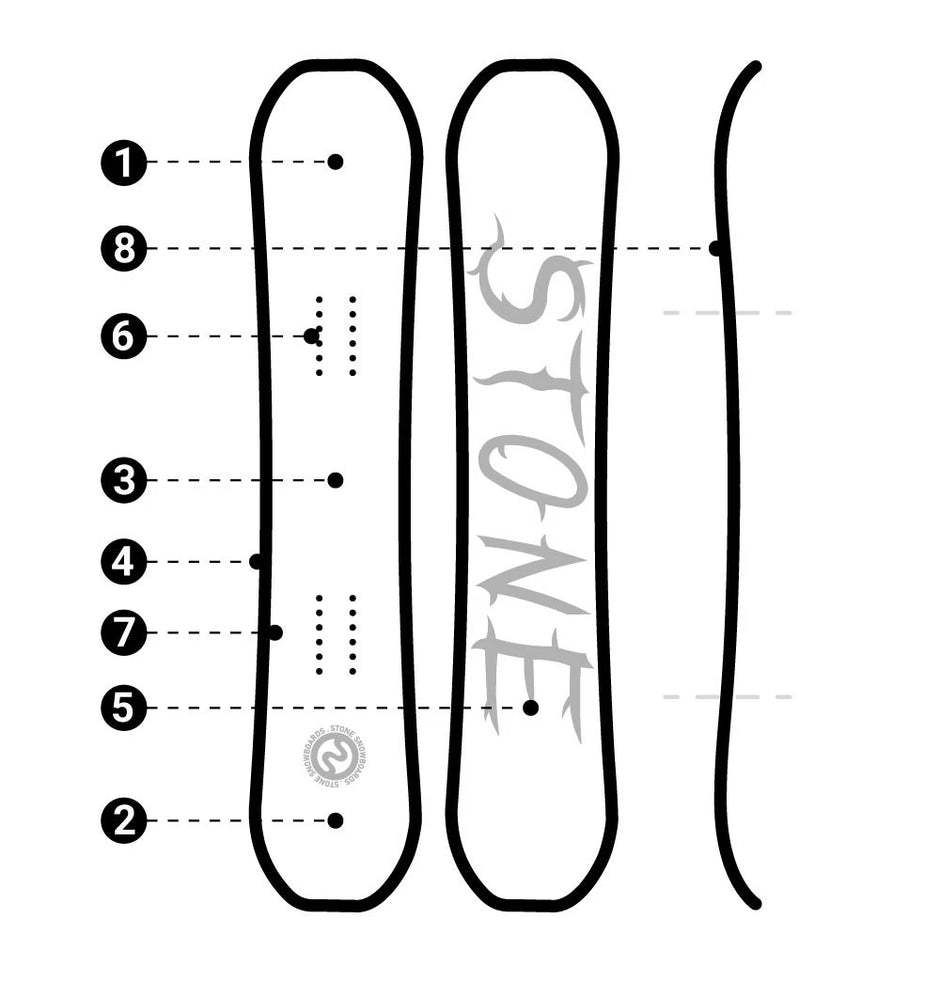
1 - La spatule (nose) : il s’agit de la partie avant de la planche, elle influence la flottaison.
2 - La queue (tail) : il s’agit de la partie arrière de la planche, qui a une influence sur la stabilité et la maniabilité de cette dernière.
3 - Le noyau : c’est la partie centrale de la planche, elle influence la flexibilité, la légèreté et la réactivité de la planche.
4 - Les carres : ce sont les bords en métal situés de chaque côté de la planche, ils ont une influence sur l’adhérence et le contrôle des virages.
5 - La semelle : il s’agit de la partie inférieure de la planche en contact avec la neige, qui a une influence directe sur la glisse.
6 - Les inserts : ce sont les trous dans la planche où les fixations sont placées, à choisir en fonction des préférences, de la taille des pieds et du style de ride pratiqué.
7 - Les champs : ce sont les côtés de la planche, qui, en plus d’offrir une protection supplémentaire, influencent l’absorption des chocs et la transmission d’énergie.
8 - Enfin, le cambre : on parle là de la courbure longitudinale de la planche (classique, inversé, plat ou hybride), qui influence la stabilité, le rebond et la qualité de prise des virages.
En ayant connaissance des différentes parties de la planche et de leur rôle respectif sur votre expérience de ride, vous disposez déjà d’éléments pertinents pour savoir comment choisir son snowboard.
Comment choisir son snowboard en fonction de son style de ride ?
Autre élément à prendre en compte pour savoir comment choisir son snowboard : il existe différents types de snowboards en fonction de votre pratique, à savoir freestyle, freeride et all-mountain.
Premier style : les snowboards freestyle.
Ils sont idéals pour les riders qui aiment faire des figures acrobatiques. Ce type de snowboard est généralement plus court, plus léger et plus souple, afin de faciliter vos manœuvres et rotations. Les snowboards freestyle sont également souvent qualifiés de twintip shape, c’est-à-dire qu’ils sont parfaitement symétriques entre l’avant et l’arrière, pour vous permettre de rider en switch.
Deuxième style : les snowboards freeride.
C’est le type de snowboard que vous devez privilégier si vous envisagez de faire des itinéraires hors-piste dans la nature. Par opposition aux planches de freestyle, les snowboards freeride sont qualifiés de directional shape, c’est-à-dire qu’ils ont l’avant plus long que l’arrière. Les snowboards freeride sont à favoriser pour faire de plus beaux virages, bénéficier d’une meilleure accroche sur neige dure ou encore de mieux flotter en poudreuse. Ils permettent de garder une plus grande stabilité à grande vitesse et d’obtenir une meilleure accroche.
Troisième style : les snowboards all-mountain.
Il s’agit d’un combo entre les deux types de planches. Les snowboards all-mountain s’adaptent à tous les terrains : pistes, hors-pistes, snowpark. Ils combinent maniabilité, stabilité et polyvalence.
Quelles sont les caractéristiques techniques d’une planche de snowboard ?
Intéressons-nous maintenant à la question de comment choisir son snowboard en fonction de ses caractéristiques techniques, à savoir sa longueur, sa largeur et son flex.
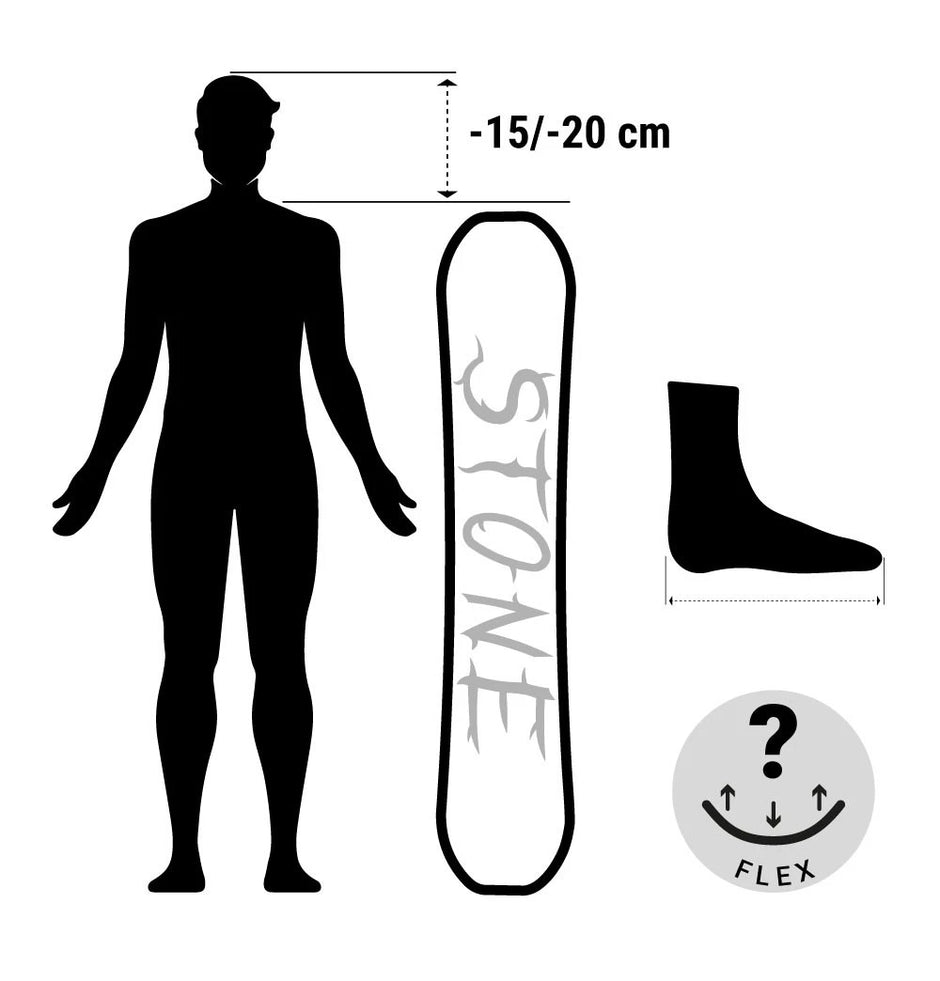
Pour sa longueur, retenez qu’il est important de choisir la planche en fonction de votre taille et de votre poids. En faisant le bon choix, vous gagnerez en maniabilité et stabilité. Pour savoir comment choisir son snowboard en fonction de sa taille, n’hésitez pas à consulter un tableau de taille. Généralement, on conseille de choisir une planche qui fait 15 à 20 centimètres de moins que votre propre taille. Elle doit donc arriver entre les épaules et le menton.
Pour la largeur du snowboard à choisir, vous pouvez assez simplement vous baser à la taille de vos pieds. C’est une métrique à prendre en compte notamment pour vous assurer un meilleur contrôle des virages. Évidemment, c’est une notion à adapter à votre situation personnelle, notamment à votre style de ride : si vous faites principalement du freestyle, vous pouvez vous tourner vers une planche légèrement plus étroite afin de gagner en maniabilité, alors qu’un rider évoluant sur de la poudreuse ou en freeride pourra choisir une planche plus large qui lui offrira une meilleure stabilité.
Enfin, quand on parle du flex du snowboard, on veut parler de sa rigidité. Pour un débutant, on privilégiera des snowboards souples qui sont globalement plus tolérants. Un snowboard rigide offrira, lui, une meilleure stabilité à haute vitesse et une réponse plus précise, et sera donc à privilégier pour des riders un peu plus confirmés.
Tenez compte de votre niveau pour bien choisir votre planche de snowboard
Bien choisir son programme est indispensable, car pour plus de plaisir et d’efficacité de ride, on mise sur un équipement optimal. Ce choix est directement lié à votre niveau, car plus on pratique, plus on a une idée précise de ce que l’on veut faire, et plus on va avoir de clés pour savoir comment choisir son snowboard.
Les niveaux avancés et experts auront déjà ridé sur des pistes, sur parks, en hors-pistes et auront développé une sensibilité particulière à telle ou telle discipline. Bien souvent, les débutants seront plus indécis, intéressés par la pratique du snowboard dans son ensemble et rêveront de pouvoir tout faire ! Dans ce cas précis, nous vous orienterons généralement vers un matériel facile qui vous permettra de progresser rapidement et ainsi d’affiner vos goûts en matière de ride. Pour vous aider à faire vos choix, voici trois exemples généraux qui vous permettront d’y voir plus clair :
1 - JE SUIS DÉBUTANT
J’aime le snowboard. Qu’il soit freestyle, allmountain ou freeride, j’aime toutes ces disciplines et j’ai beaucoup de mal à me décider ! Comme dans tous les sports, certaines pratiques réclament expérience et lucidité. J’ai conscience que me jeter tout de suite dans un park ou du sommet d’une montagne enneigée sans réfléchir peut s’avérer dangereux. J’ai d’abord besoin de progresser, pratiquer et mieux comprendre ce sport pour affiner mes goûts en matière de ride. Dans ce cas je vais plutôt m’orienter vers une board freestyle avec un shape twin tip et un flex qui pardonne -presque- tout. Je pourrais alors expérimenter les pistes et leurs bords, attaquer progressivement des passages de poudreuse en appuyant bien sur ma jambe arrière et pourquoi pas tenter quelques sauts et rails sur des parks adaptés.
2 - J'AI UN NIVEAU INTERMÉDIAIRE
J’ai déjà expérimenté les pistes, un peu de park et quelques descentes en freeride. Je n’ai pas vraiment développé de sensibilité particulière, j’aime le snowboard dans son ensemble et n’envisage pas forcément d’acquérir une planche trop spécifique. Dans ce cas je m’orienterai vers une board allmountain avec un léger set-back (fixations reculées sur la planche afin de soulager la jambe arrière en pratique freeride). Dotée d’un flex généralement un peu plus rigide, elle me permettra de passer partout sans forcer. Plus stable, plus rapide, moins fatiguant et plus précise en freeride elle fait facilement figure de matériel de base lorsqu’on possède plusieurs planches spécifiques à chaque pratique (quiver).
3 - J'AI UN NIVEAU AVANCÉ
J’ai fait le tour de la question. Cela fait quelques années que je ride avec une board freestyle ou allmountain et me débrouille plutôt bien ! Seulement voilà, non pas que ce soit ennuyeux mais j’aimerai encore sentir le goût du renouveau, être surpris par un shape, une précision dans les courbes, je veux vibrer à nouveau comme lors de ma première descente ! Je vais m’orienter vers des boards plus atypiques, plus typées. L’heure est venue de m’intéresser au shape directionnel, au rocker progressif et à des boards si précises que je vais pouvoir réinventer ma pratique, sur piste et hors-piste. J’ai conscience qu’elle sera plus difficile à gérer en freestyle, mais encore une fois rien n’est impossible ! Je n’ai pas envie d’abandonner mes facilités en park pour autant, je vais donc conserver cette belle board qui m’aura fait grandir et évoluer et me constituer un quiver. Je serai ainsi équipé de manière optimale pour parer à toutes mes envies et situations !
Considérez votre budget pour acheter une planche de snowboard
On le sait, un snowboard est un investissement. Il vous faudra dépenser plusieurs centaines d’euros pour vous en procurer un, et encore un peu plus pour tous les équipements annexes. C’est pourquoi nous vous conseillons de faire un choix durable : n’ayez pas peur d’investir dans un produit fiable.
Chez Stone Snowboards Canada, on vous offre aussi la possibilité de choisir des planches dans notre page Liquidation pour bénéficier de prix cassés sur des planches de snowboards et splitboards de seconde main ou fin de série.
En conclusion, la question de comment choisir son snowboard est essentielle si vous voulez profiter pleinement de votre expérience de glisse. Plusieurs facteurs doivent être pris en compte : votre style de ride, votre niveau de compétences, votre morphologie ou encore votre budget. N’hésitez pas à consulter des professionnels comme Stone Snowboards qui sauront vous aiguiller et vous donner des conseils personnalisés. Et pour êtres sûr de ne pas faire d’impair, achetez directement un pack snowboard, comprenant la board de votre choix et les fixations assorties. À bientôt les Stoners !
English
Whether you're a beginner, intermediate or experienced rider, choosing the right snowboard is essential to improving your performance and getting the most out of every day on the mountain.
The benefits are numerous: better performance through improved maneuverability and stability, increased confidence and safety on your board, greater comfort without unnecessary pain or discomfort, and an overall better riding experience with a snowboard that truly matches your expectations and specific needs.
The team at Stone Snowboards Canada is here to share its expert advice in this complete guide: How to Choose the Right Snowboard.
Understand the Basics of a Snowboard
Let's start with the basics. Before looking at the different factors involved in choosing the right snowboard, it's important to understand its main components. Each part has a specific purpose and directly influences your riding experience and performance.
-
The Nose: The front of the snowboard. It plays an important role in floatation, especially in powder snow.
-
The Tail: The rear of the snowboard. It influences stability, maneuverability and overall riding performance.
-
The Core: The central structure of the snowboard. It affects flex, weight and responsiveness.
-
The Edges: The metal strips running along both sides of the board. They provide grip and control when carving and making turns.
-
The Base: The bottom surface of the snowboard that comes into contact with the snow. It has a direct impact on glide and speed.
-
The Inserts: The mounting points where your bindings are attached. Their positioning can be adjusted according to your preferences, boot size and riding style.
-
The Sidewalls: The sides of the snowboard. In addition to protecting the core, they help absorb impacts and transfer energy.
-
The Camber Profile: This refers to the snowboard's longitudinal shape or curvature (traditional camber, reverse camber, flat or hybrid). It influences stability, pop and edge hold when turning.
Understanding these different components and how they affect your riding experience already gives you a solid foundation for choosing the right snowboard.
How to Choose a Snowboard Based on Your Riding Style
Another important factor when choosing a snowboard is your preferred riding style. Generally, snowboards are designed around three main disciplines: freestyle, freeride and all-mountain.
1. Freestyle Snowboards
Freestyle snowboards are ideal for riders who love tricks, jumps, rails and riding in the terrain park.
These boards are generally shorter, lighter and softer, making rotations, tricks and maneuvers easier.
Freestyle snowboards are also often designed with a true twin shape, meaning the nose and tail are perfectly symmetrical. This allows you to ride comfortably in both your regular stance and switch.
2. Freeride Snowboards
If you enjoy exploring backcountry terrain and riding off-piste, a freeride snowboard may be the right choice.
Unlike freestyle boards, freeride snowboards typically feature a directional shape, meaning the nose is longer or more pronounced than the tail.
These boards are designed to deliver smoother turns, better edge hold on firm snow and improved floatation in powder. They also provide greater stability at higher speeds and excellent control in challenging terrain.
3. All-Mountain Snowboards
All-mountain snowboards combine elements of freestyle and freeride designs.
They are designed to handle just about any terrain, from groomed runs and powder to the terrain park.
Their versatility makes them an excellent choice for riders looking for a balance of maneuverability, stability and performance across the entire mountain.
What Technical Features Should You Consider When Choosing a Snowboard?
Now let's look at the technical characteristics that matter most when choosing a snowboard: length, width and flex.
Snowboard Length
Choosing the right snowboard length depends primarily on your height and weight.
Getting the right size will help improve both maneuverability and stability.
As a general guideline, snowboard length is often recommended to be approximately 15 to 20 cm shorter than your height. The board should typically reach somewhere between your shoulders and chin.
However, this is only a starting point. Your weight, riding style, experience and the specific design of the snowboard should also be considered.
Consulting a snowboard size chart is always a good idea before making your final decision.
Snowboard Width
The width of your snowboard should primarily be determined by your boot size.
Choosing the correct width is important to ensure proper edge control and avoid excessive toe or heel drag when turning.
Your riding style also plays a role. Freestyle riders may prefer a slightly narrower board for quicker edge-to-edge transitions and improved maneuverability.
On the other hand, riders spending more time in powder or freeride terrain may benefit from a wider snowboard offering additional stability and floatation.
Snowboard Flex
When we talk about snowboard flex, we're referring to how stiff or soft the board is.
For beginners, softer snowboards are generally recommended because they are more forgiving and easier to control.
Stiffer snowboards, on the other hand, provide greater stability at high speeds and more precise response. They are generally better suited to intermediate, advanced and expert riders looking for increased performance and control.
Consider Your Riding Level When Choosing a Snowboard
Choosing the right type of snowboard is essential if you want to maximize both enjoyment and performance.
Your riding level plays a major role in this decision. The more experience you gain, the better you understand your preferences and the type of terrain and riding style you enjoy most.
Advanced and expert riders have usually experienced groomed runs, terrain parks and backcountry conditions. Over time, they develop a preference for specific disciplines.
Beginners, however, are often less certain. They love snowboarding in general and dream of being able to ride everything!
In this situation, we generally recommend equipment that is easy to handle and forgiving, allowing you to progress quickly and discover your own riding style.
Here are three general examples to help you make the right choice.
1. I'M A BEGINNER
I love snowboarding! Whether it's freestyle, all-mountain or freeride, I enjoy all these disciplines and have a hard time choosing just one.
Like any sport, certain disciplines require experience, skill and good judgment. I understand that jumping straight into the terrain park or dropping into a steep backcountry line without the proper experience can be dangerous.
First, I need to improve my skills, gain experience and better understand the sport before developing my preferences.
In this case, I would lean toward a freestyle snowboard with a twin-tip shape and a forgiving flex that can handle just about anything I throw at it.
This will allow me to explore groomed runs and their edges, gradually venture into powder by putting more pressure on my back foot, and perhaps even try a few jumps and rails in beginner-friendly terrain parks.
2. I'M AN INTERMEDIATE RIDER
I've already experienced groomed runs, spent some time in the terrain park and enjoyed a few freeride descents.
I haven't necessarily developed a strong preference for one discipline. I enjoy snowboarding as a whole and don't particularly want a board designed for just one specific purpose.
In this case, I would choose an all-mountain snowboard with a slight setback stance (bindings positioned further back on the board to reduce pressure on the back leg when riding in freeride conditions).
With a slightly stiffer flex, this type of board will allow me to ride just about anywhere without having to work too hard.
More stable, faster, less tiring and more precise in freeride conditions, an all-mountain snowboard is also an excellent everyday board for experienced riders who own several specialized boards for different riding styles (a quiver).
3. I'M AN ADVANCED RIDER
I've been around the mountain. I've spent several years riding freestyle or all-mountain boards and feel pretty comfortable with my abilities!
But here's the thing: it's not that snowboarding has become boring. I simply want to rediscover that feeling of excitement. I want to be surprised by a new shape, experience greater precision through turns and feel that same excitement I had during my very first run!
I'm ready to explore more specialized and unconventional snowboard designs.
It's time to discover directional shapes, progressive rocker profiles and highly responsive boards that will allow me to reinvent the way I ride, both on groomed runs and in the backcountry.
I understand that these boards may be more challenging to handle in the terrain park, but that doesn't mean anything is impossible!
I don't want to give up the freestyle board that has helped me grow and progress over the years. Instead, I'll keep it and start building my own quiver.
That way, I'll always have the right board for every type of terrain, condition and riding adventure!
Consider Your Budget When Buying a Snowboard
Let's face it: buying a snowboard is an investment.
You'll need to spend several hundred dollars on a board, and even more when you factor in additional equipment such as bindings, boots and other accessories.
That's why we recommend making a smart, long-term investment. Don't be afraid to spend a little more on reliable, quality equipment that will last.
At Stone Snowboards Canada, we also offer great opportunities to save through our Liquidation section, where you can find discounted snowboards and splitboards, including pre-owned equipment and end-of-season models.
Final Thoughts: How to Choose the Right Snowboard
Choosing the right snowboard is essential if you want to get the most out of your time on the mountain.
Several factors should influence your decision: your riding style, skill level, body type and budget.
Don't hesitate to consult snowboard professionals like the team at Stone Snowboards Canada. We'll be happy to guide you through the process and provide personalized advice based on your needs.
And if you want to make things even easier, consider purchasing one of our snowboard packages, which include the board of your choice and compatible bindings.
See you on the mountain, Stoners!


